Showing posts with label World War I. Show all posts

Monday, April 17, 2017

N - Nieuwpoort, Belgium

Nieuwpoort is located in Flanders and is comprised of the city proper and the towns of Ramskapelle (where the cemetery is located that I showed for Flanders) and Sint-Joris.  We were here to see the Monument to King Albert I, the Soldier King, that was constructed to honor him in 1938.

The German army invaded Belgium in 1914, up until Nieuwpoort, near the sea, where they came to a grinding halt. This was achieved through the power of seawater and the smart coordination of the sluices and locks, which were opened to inundate the city.  While the Germans were stopped, the city itself was destroyed.


The banks of the Yser River

The word 'Yser'  is often seen in crossword puzzles.  Do you do crosswords?  Did you know the significance of the river  before reading this?  

Bonus:  Ninebark shrub


Friday, April 7, 2017

F - Flanders Fields, Belgium

Yesterday, April 6, marked the 100th Anniversary of America's entry into World War I.  This post is dedicated to all the men and their families who lost so much in the Great War.


By Lieutenant Colonel John McCrae

In Flanders fields the poppies blow
Between the crosses, row on row,
That mark our place: and in the sky
The larks still bravely singing fly
Scarce heard amid the guns below.

We are the dead: Short days ago,
We lived, felt dawn, saw sunset glow,
Loved and were loved: and now we lie
In Flanders fields!
Take up our quarrel with the foe
To you, from failing hands, we throw
The torch: be yours to hold it high
If ye break faith with us who die,
We shall not sleep, though poppies grow
In Flanders fields

Composed at the battlefront on May 3, 1915
during the second battle of Ypres, Belgium

Ramscappelle Road Military Cemetery - There are many photos on this site and more explanation


The Stone of Remembrance
Do you have an interest in visiting battlefields and commemorative sites?  Have you visited many?

Bonus:  Daylily 'Frosted Vintage Ruffles'

Tuesday, April 29, 2014

Y, Y, Y, Y???


The question asked again and again at the Nuremberg trials.  Why?

The partition of Germany after the war with fences and guard towers as seen in Modlareuth.  Why?

The ongoing conflict in the world.  WHY???


NOTE:  Yesterday was Holocaust Remembrance Day.  You can find more information here.

I have had an interest in Germany and German history ever since high school.  My world history teacher (1962-63) was German and, when it came to history, she spent a lot of time discussing Germany in the late 19th and first half of the 20th centuries.  Since then I've had an interest in understanding how three first cousins could go to war (WWI) against each other:  Kaiser Wilhelm II of Germany, King George V of Great Britain, and Tsar Nicholas II of Russia. And then have their successors repeat the war just 25 years later.

World War I had no winner.  It ended out of sheer exhaustion of the participating countries.  Germany put Lenin on a train and sent him into Russia to put the latter's focus on the home front situation.  I previously reviewed the book  "To End All Wars" which deals with the war, mostly from a British perspective.

On a previous trip to Europe I viewed the palaces of the Hapsburg Dynasty that ended with the first World War.  When I planned this trip, I was particularly focused on seeing those areas of the country so pivotal in World War II - Berlin, Cologne, Munich, Nuremberg, Dachau, Potsdam, Dresden...  Many of these I have already mentioned in this challenge.

The guides I had were all well-versed in German history.  Every time I turned on a TV in Germany there was some station showing a program about the World Wars (in German so I had no idea what they were saying, but the topic was clear).  The motto everywhere seemed to be 'Never Forget'.

I heard the question asked again and again about "Y" did people listen to Hitler?  But think about it.  We hear what we want to hear from whomever is delivering the message.  If a country is struggling, they look to blame someone for their problems.  Hitler gave them peoples to blame.  They look to a leader, any leader who will tell them what they want to hear.

It seems rather inconceivable that they would follow so willingly.  But ask yourself this:  Do I follow willingly what my political party leaders, religious leaders, social contacts, or even my boss says without any independent thinking?  How many people watch TV and follow whatever Dr. Oz has to say without verifying his sources of information???  (this is a pet peeve of mine, sorry folks)

On this trip I marveled at the German people's ability to rebuild their country after the war, even though it took many, many years.  (And no, I have no German blood lines on either side of my family.  As a matter of fact, my mother's family had their farm in northern Italy taken from them by the Germans in World War I.)  The Germans have an intense enthusiasm and national pride.  I was in Berlin during the Reunification Day ceremonies and the city was packed.  It was like America on the 4th of July.

In the following pictures I will cover some of the areas dealing with the war.  I'll let the photos do my talking for me.

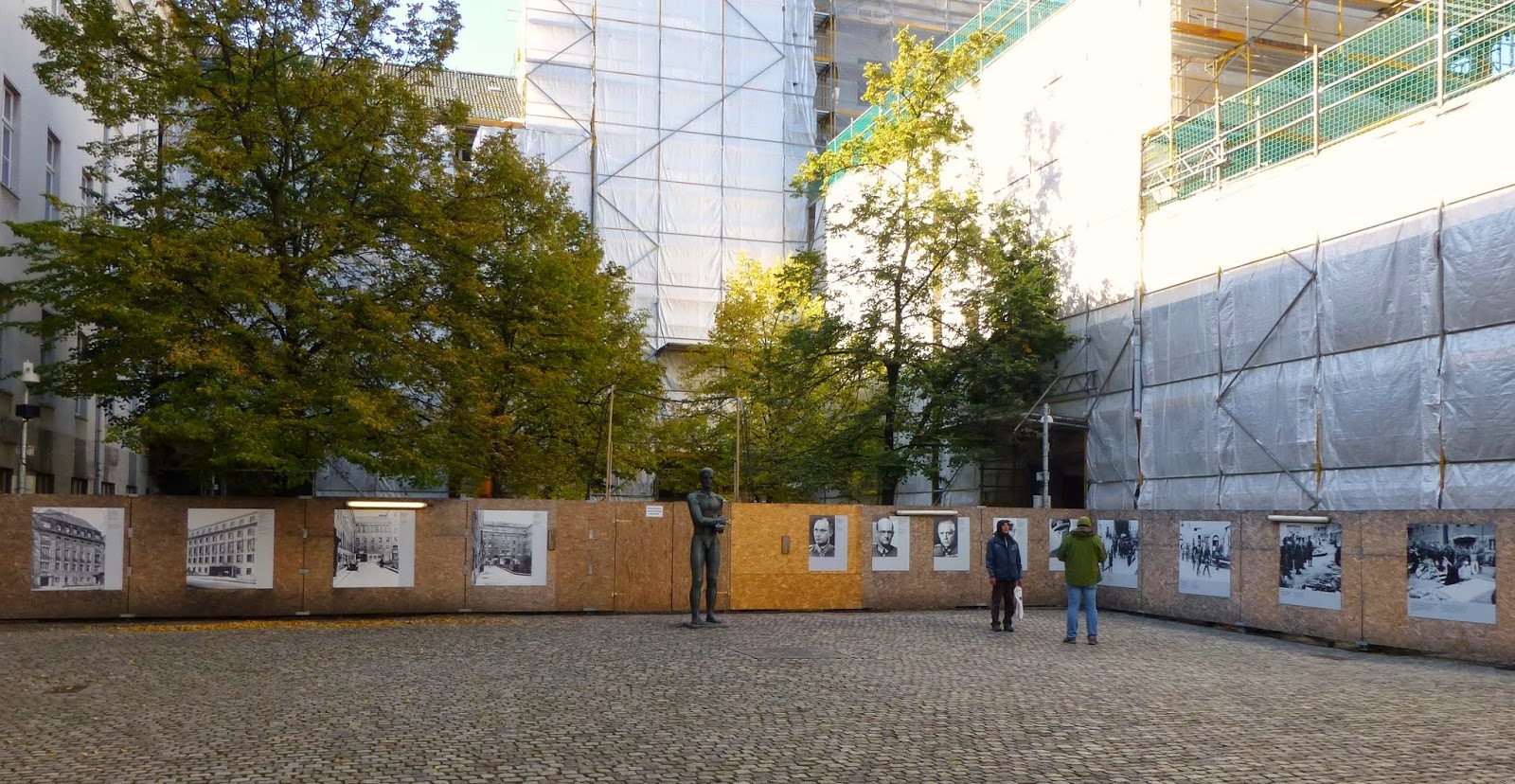
In Berlin we visited the Bendler Block courtyard to see the outdoor memorial to the German Resistance:


The plaque with the names of the men who lost their lives after a failed attempt to assassinate Hitler.

The story was made into several movies, most recently 'Valkyrie'.


There are many memorials to those who died in concentration camps including this Holocaust Memorial in Berlin:


And this sculpture in Frankfurt:


One could spend an entire day at the Topography of Terror Museum.  There are both indoor and outdoor exhibits.  This is part of the wall outside:


While I may do a future post about the City of Nuremberg, for now the place to see there is the Documentation Center on the former Nazi Party Rally Grounds.


This is what is left of the outdoor area:


The exhibits here and at the Topography of Terror are well worth the time it will take to adequately understand what was happening if you were not living at the time or have not studied this era in history.  Nuremberg is also the home to the Palace of Justice where the Nuremberg Trial verdicts were handed down:


And if what had happened in World War II wasn't enough, the Russians put barriers up around East Germany and in the case of Modlareuth, split the town right in half, separating families for 24 years (1966 - 1990).  Imagine seeing this in your backyard:


Truly war has no winners, only survivors.

On my Bucket List:  Yangtze River cruise

Saturday, April 26, 2014

W is for Weimar Republic and World Wars


At the end of World War I in 1918, the Weimar Republic was established in Weimar, Germany.  The Treaty of Versailles imposed very oppressive requirements on Germany whose government pushed for the start of the war. War reparations were hefty to say the least. The government started printing money which led to hyperinflation. Money became essentially worthless. People became dissatisfied and felt oppressed. 


In a nutshell, the terms of the Treaty of Versailles set the stage for the rise of the Third Reich and the beginnings of World War II, just as hard feelings from the end of the Franco-Prussian War led to the start of WW I.

Ultimately, the Weimar Republic could no longer afford to pay the Allies its reparations. 

The government structure in Weimar came to an end after fourteen years with the establishment of the Third Reich and the Nazis.  And the road from 1933 onward led to the start of World War II in 1939 with the invasion of Poland by Germany on September 1.  

Weimar is also a UNESCO World Heritage Site. 

On my Bucket List:  Wuhan, China

Sunday, April 21, 2013

A Sunday Book Review - 'To End All Wars'

I have been busy writing my  A-Z Challenge posts, which has left little time for much else other than my yoga classes.  Don't get me wrong.  I am having a wonderful time reliving my past trips and on the plus side, all of my photos are now in really great shape!

To End All Wars: A Story of Loyalty and Rebellion, 1914-1918

Consequently, it has taken me several weeks to read Adam Hochschild's account of World War I, 'To End All Wars'. But, I finished it Wednesday night and am glad I stuck with it.
Even had I not been busy with blogging, it would not have been a fast read.  It is an historical account, not historical fiction.  Like going to see the movie 'Titanic', you already know the ending. 

My knowledge of this war before reading the book consisted of knowing the impetus and the date of the Armistice.  The impetus was the assassination of Archduke Ferdinand in Sarajevo in June, 1914.  The Armistice was signed on November 11, 1918.  And I knew that there were great numbers of casualties, just not how many.

 
Hochschild concentrates his writings on the war as experienced by Great Britain.  Before reading the book the only names familiar to me were Bertrand Russell and Rudyard Kipling.  But Hochschild gets into the lives of those both in agreement with the conflict and those protesting the war.  He follows them from their lives prior to the conflict to where they died years after the war's end.

I learned that Germany transported Lenin from Switzerland to Russia after the uprising there to depose the Tsar.  I also learned that Germany urged Austria to declare war so that they could have another shot at French territory.  And it was a 'family affair' with German, Russian and British royals all related to each other.

Those of you who watch 'Downton Abbey' may have seen the trench warfare depicted.  It was much more awful than I ever imagined.  The war was a ghastly stalemate from 1915 until the armistice and soldiers were making bets on where the front line would be in 50 years.  The lack of expertise and knowledge of both the political and military leadership of virtually every participating nation is astonishing.  But the numbers of casualties is really hard to fathom:  “more than 8.5 million soldiers were killed on all fronts,” with civilian deaths “estimated at 12 to 13 million”.  According to Hochschild, the flu that took so many lives at the end of the war was brought to Europe by U.S. soldiers being deployed from a camp in Kansas.  (Did I read that correctly?)

Two weeks ago when I was working my volunteer shift at the library, I struck up a conversation with an older gentleman (78).  He asked me what I was reading and I told him.  He told me that he was imprisoned in a concentration camp during World War II and that the only members of his family to survive were he and his mother.  He also said that World War I and the botched treaties set the stage for World War II.  He was absolutely correct. 

France was given the lead in dictating the terms of the armistice and the Treaty of Versailles to be signed in 1919.  The terms laid down left Germany bitter, angry and vindictive, and paved the way for Hitler and the cataclysm that followed. 

This war saw the end of the Austro-Hungarian Empire, the Germany Empire, the Ottoman Empire, and the Russian Empire.  Unfortunately, it did not 'end all wars'.

This is a book I would recommend for anyone interested in history.